
Isometric Training for Athletes: How It Builds Force and Control
By Matt Pack · August 24, 2026
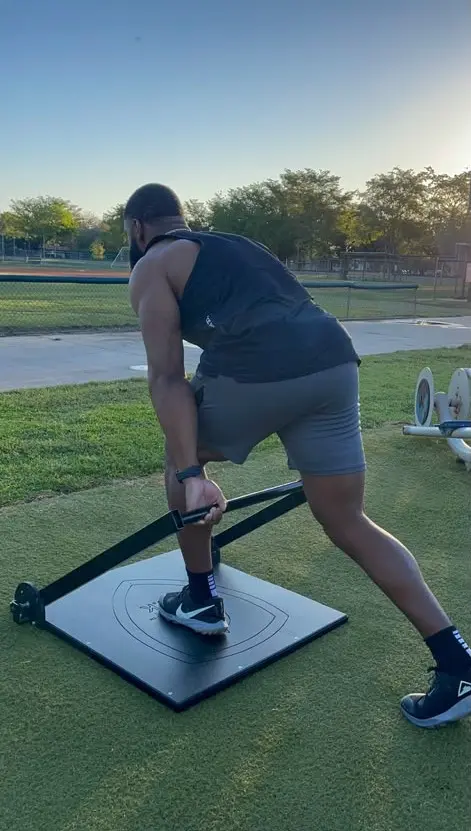
Isometric training can help athletes develop force in specific positions, strengthen their ability to hold or resist a position, and add targeted muscular and tendon loading without repeated lifting and lowering. It is not a substitute for sprinting, jumping, cutting, dynamic strength training, or sport practice. Used well, it is one more precise tool inside a complete performance program.
At Primal Fit Miami, we use the ISOPHIT system with adults who want to stay strong as they age, and we have used the same system with elite athletes, including NFL players. The equipment may be the same, but the coaching goal, intensity, position, and progression are not.
That is the point many people miss. Isometrics are not only for rehabilitation, and they are not only for older adults. They can be demanding strength work for an athlete when the exercise and dose match the sport and the person.
What Is Isometric Training?
Isometric training is a form of strength training in which the muscles produce force while the working joint stays relatively still. An athlete may hold a position against gravity or push or pull against resistance that does not move.
A wall sit and a plank are familiar examples, but athletic isometrics can be much more specific. A coach can select a joint angle, adjust body position, prescribe a duration, and cue the athlete to build force gradually or produce it as quickly as possible. Those variables change the training effect.
Research supports an important principle: isometric strength gains are partly specific to the positions and contraction qualities that are trained. That specificity can be useful, but it is also why isometrics should be programmed with a clear purpose rather than added as random holds.[1]
If you want the broader picture first, we cover how isometric exercise builds strength in a separate article.
Why Athletes Use Isometric Training
Athletes do not use isometrics because standing still looks like their sport. They use them because sport repeatedly asks the body to create, transmit, absorb, and resist force. A well-chosen isometric exercise can isolate one part of that demand and train it under controlled conditions.
1. Develop High Force in a Controlled Position
An isometric contraction can be extremely demanding even though little visible movement occurs. By removing the need to accelerate and decelerate an external load through repeated repetitions, the coach can focus closely on position and force production.
This does not mean isometrics are automatically low stress or appropriate for every athlete. High-intensity efforts create substantial internal loading. The advantage is control: position, effort, duration, rest, and progression can all be selected deliberately.
2. Strengthen Positions That Matter
Every sport contains positions where an athlete must stay organized under force. A lineman holds ground, a tennis player controls a low position before changing direction, and a runner must keep the hip, knee, ankle, and trunk coordinated while force travels through the body.
Because isometric adaptations can be joint-angle specific, coaches may use holds or overcoming isometrics to strengthen a position where the athlete needs more force or control. That work must still transfer into movement practice. Owning a position in the gym does not automatically produce better technique on the field or court.
3. Train Force-Time Qualities
Athletic performance is not only about how much force an athlete can produce. It also matters how quickly that force becomes available. Isometric tests and exercises can give coaches information about peak force, rate of force development, and impulse.
A systematic review found that force-time measures from multi-joint isometric tests were associated with a range of dynamic performance measures in athletes and active adults. Association is not the same as proof that an isometric program alone will improve sprint or jump performance, but it helps explain why these measures are useful in athlete assessment and training.[2]
4. Provide Targeted Tendon Loading
Tendons adapt to mechanical loading, and high-intensity resistance work can increase tendon stiffness and other mechanical properties over time. Isometric contractions are one way to provide that loading. Systematic reviews suggest that intensity, duration, frequency, joint position, and the tendon being trained all influence the response.[3]
Tendon stiffness is not a universal score where more is always better. Different sports and athletes have different demands, and tendon adaptation takes time. It is more accurate to say that isometrics can contribute to a progressive loading plan than to claim they make every tendon more resilient.
Isometric Training and the Knee: Where ACL Claims Need Care
ACL injuries do not happen simply because an athlete is not strong. Risk is multifactorial and can involve sport exposure, previous injury, anatomy, fatigue, movement strategy, landing and cutting demands, training load, and other factors.
Isometric exercises can help train the quadriceps, hamstrings, hips, calves, and trunk in selected positions. That may be a useful strength component of knee preparation. It should not be described as a stand-alone ACL prevention method.
The stronger evidence supports comprehensive neuromuscular programs that combine lower-body strength with landing and deceleration practice, balance, plyometrics, agility or change-of-direction work, and consistent implementation. A 2026 systematic review and meta-analysis found lower ACL injury rates among athletes who completed prevention programs, but more than 85 percent of the studied athletes were female and the interventions were multi-component programs, not isometrics alone.[4]
For coaches, the practical takeaway is straightforward: use isometrics where they solve a specific strength or positioning problem, then connect that work to dynamic strength, landing, cutting, sprinting, and sport practice.
What Isometrics Cannot Replace for an Athlete
Specificity still matters. Football, tennis, basketball, soccer, running, and field sports are dynamic. Athletes must accelerate, brake, rotate, react, and make decisions at speed. Isometrics alone cannot develop every quality those tasks require.
A complete athletic plan may include:
- Dynamic strength through appropriate ranges of motion
- Sprinting, jumping, throwing, or other power work
- Landing, braking, and change-of-direction practice
- Mobility and movement options appropriate to the sport
- Aerobic and anaerobic conditioning
- Sport-specific skill, decision-making, and exposure
- Recovery and training-load management
Isometrics earn their place by doing a defined job inside that plan. They lose value when they are presented as a replacement for movement.
The Same System Can Serve Different People
One reason I value ISOPHIT is that the stimulus can be scaled to the human using it. An NFL player can perform a high-intensity effort for a performance goal. A 55-year-old executive can train force in a controlled position. A 70-year-old can work on strength and stability at a level that reflects their current ability. We look at that side of the work in more detail in our article on isometric strength and longevity after 50.
The underlying principle is the same: muscles create force. Good coaching decides how much force, in what position, for how long, and for what purpose.
The program names and service paths are different. At Primal Fit Miami, athletes interested in individualized performance work should start with a personal training consultation. Prime Strength 30™ is our separate 12-week, coach-led ISOPHIT program designed for adults 50+.
How Primal Fit Miami Integrates Isometrics
We do not look at isometric training as a rival to traditional strength training. We integrate it where it makes the overall plan better.
That may mean using an isometric to develop force in a selected position, adding targeted loading without another set of repeated lifts, or teaching an athlete to create tension while maintaining alignment. It may also mean leaving isometrics out when another method is better suited to the goal.
The goal is not to collect training methods. The goal is to prepare the athlete for their arena, whether that is an NFL field, a tennis court, a road race, or a demanding recreational sport.
Train the Quality, Then Connect It to the Sport
Isometric training can help athletes build force, strengthen selected positions, and add purposeful muscular and tendon loading. Its value comes from precise programming and from how well the coach connects the work to dynamic training and sport demands.
If you are an athlete in Miami or Miami Shores and want to understand whether isometrics belong in your training plan, start with a conversation. Primal Fit Miami can assess your goals, training history, and current program, then help determine which training option is the right fit.
Schedule a Consultation With Primal Fit Miami
Frequently Asked Questions
Are isometrics good for athletes?
Yes, when they are programmed for a specific purpose. Isometrics can improve force production, strengthen selected joint positions, and provide targeted muscular and tendon loading. They should complement, not automatically replace, dynamic and sport-specific training.
Can isometric training improve speed or jumping?
It may contribute by improving force-related qualities, but transfer is not automatic. Speed and jumping also require rapid coordination, elastic qualities, technique, and dynamic practice. The exercise position, intensity, intent, and overall program all matter.
Do isometrics prevent ACL injuries?
No single exercise can guarantee ACL injury prevention. Isometric strength work may be one component of a broader risk-reduction plan that also includes dynamic strength, landing and deceleration practice, balance, plyometrics, change-of-direction training, and consistent sport-specific preparation.
Are isometrics easier on the joints than lifting?
They can reduce repeated joint movement and allow a coach to choose a controlled position. That does not make them risk-free or appropriate for every joint, symptom, or health condition. High-intensity isometrics can be very demanding.
What is the difference between ISOPHIT and Prime Strength 30™?
ISOPHIT is the isometric strength-training system. Prime Strength 30™ is Primal Fit Miami's proprietary 12-week program for adults 50+ that uses ISOPHIT within a coached small-group format. The same system may be used in other coaching contexts, including individualized athlete training.
Research References
- Oranchuk DJ, Storey AG, Nelson AR, Cronin JB. Isometric training and long-term adaptations: effects of muscle length, intensity, and intent. Scandinavian Journal of Medicine & Science in Sports. 2019. View study
- Lum D, Haff GG, Barbosa TM. The relationship between isometric force-time characteristics and dynamic performance: a systematic review. Sports. 2020. View study
- Bohm S, Mersmann F, Arampatzis A. Human tendon adaptation in response to mechanical loading: a systematic review and meta-analysis. Sports Medicine Open. 2015. View study
- Watson SL, et al. A systematic review and meta-analysis of anterior cruciate ligament injury prevention programs: training to stay in the game. American Journal of Sports Medicine. 2026. View study
- Supporting ACL programming guidance: Petushek EJ, et al. Evidence-based best-practice guidelines for preventing ACL injuries in young female athletes. American Journal of Sports Medicine. 2019. View study
This article is general fitness information, not medical advice. Individual results vary.
Train with Miami's most trusted gym
Book a free consultation - we'll build the right plan for you.